 Darija Pro
How do you conjugate a verb in darija?
A darija verb is conjugated with prefixes and suffixes around a short root. In the present, ka- goes in front: kanbghi, I want. In the future, ghadi goes before the verb. The past is marked by an ending: bghit, I wanted. The negation wraps the verb with ma…ch: ma bghitch, I did not want. And the feminine changes the “you” form: katbghi to a man, katbghay to a woman.

Conjugate bgha (to want) in the present
- Find the present stem. For bgha, the present stem is bghi. The app's entry shows it at the top: past bgha, present bghi.
- Add ka- and the person marker. ana kanbghi (I), nta katbghi (you, to a man), nti katbghay (you, to a woman), howa kaybghi (he), hia katbghi (she).
- For the future, put ghadi in front. ghadi nwjdo: we are going to prepare. ghadi marks the future, the verb follows without ka-.
- To say no, wrap with ma…ch. ma kanbghich: I don't want. ma goes before, ch sticks to the end. In the app, the “Negative” toggle applies it to the whole table.
The present in darija: the prefix ka-
The present, and the habit, are marked with ka- before the verb form. The ka- merges with the person marker: kan- for I, kat- for you and she, kay- for he. kanbghi, katbghi, kaybghi. It is the number one difficulty for learners, and the reason the app opens every verb directly on the Present tab.
The past: an ending, no auxiliary
No “have” or “be”. The past is read in the ending: bghit, I wanted; bgha, he wanted. The word bghit also works as a polite “I want”: bghit kas d atay 3afak, I would like a glass of tea, please.
The future: ghadi
ghadi, literally “going”, goes before the verb: ghadi nwjdo couscous, we are going to make couscous. It does not change with the person in everyday use. The verb that follows carries the marker.
The negation ma…ch and the feminine
The negation frames the verb: ma bghitch, ma kanbghich. In the app, the “Negative (ma … ch)” toggle recalculates the whole table in one move.
The feminine is the part school tables forget. To a woman you say nti katbghay. To a man, nta katbghi. The app marks every feminine form with a tag and shows the variant when one exists: also katbghi.
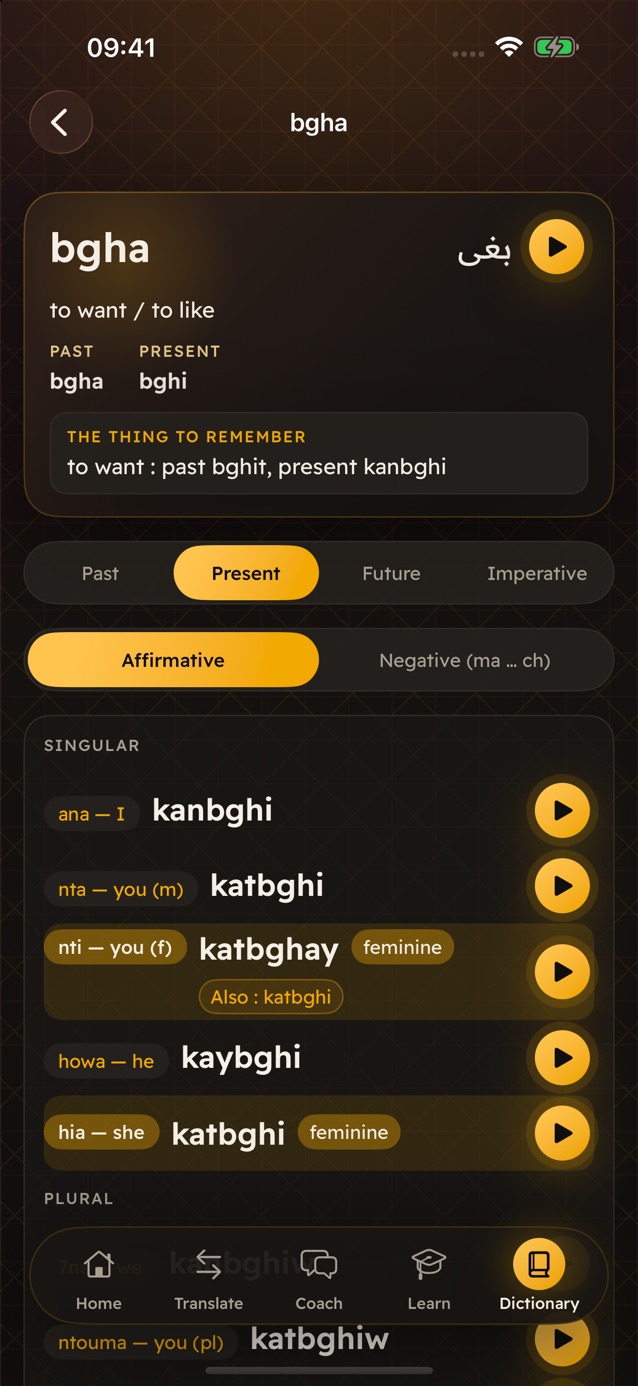
620 conjugated verbs, with a voice, offline
The app conjugates 620 verbs in the past, present, future and imperative, close to 17,000 forms, with the negation and the feminine. Every form has its Moroccan voice, and every verb comes with “the thing to remember” in one line. It all ships inside the app, with no connection needed. In Learn, the “Complete the form” drill makes you pick the right conjugation out of four.
Questions about this guide
Why isn't kteb read “kataba”?
Because darija lost most of the short vowels of Standard Arabic. kteb (he wrote) is said in one block, with no a between the consonants. The play disc lets you hear it.
Does the imperative exist in darija?
Yes: aji (come), jib (bring). The app gives it its own tab for every verb, in the masculine, feminine and plural.